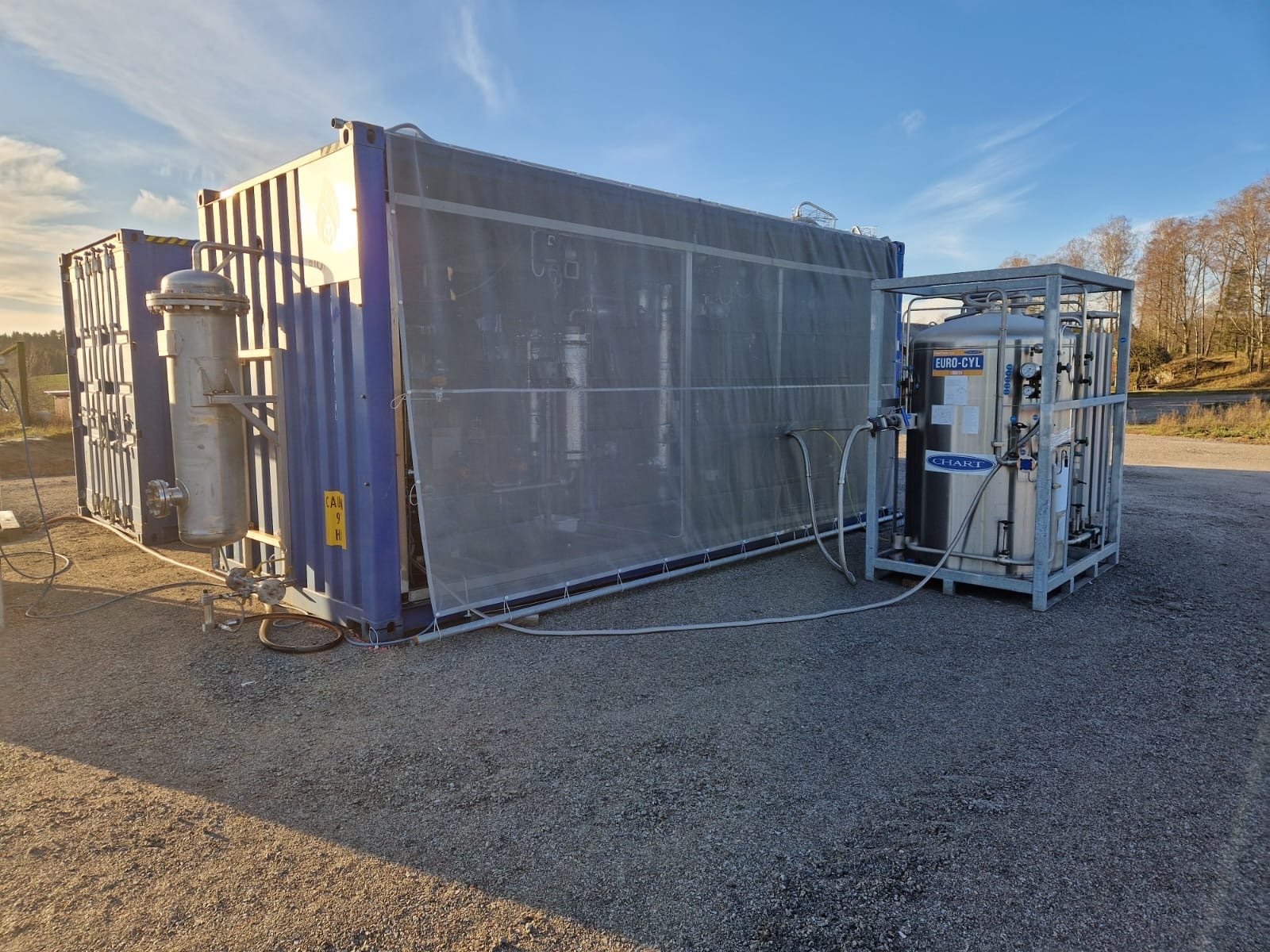
We have produced a series in which, over five Thursdays, you will be able to follow farmer Dan Waldemarsson and hear his thoughts on the following questions:
- Why is the investment in liquid biogas so important for the farm?
- What does upgrading and liquefying the gas involve in practical terms?
- What would it mean if local transport vehicles could refuel from the farm?
- How does Dan view the investment’s significance for the farm’s profitability?
- What is the vision for the future of biogas at farm level?
Biofrigas’ first plant is located at Långhult Farm outside Habo. Farmer Dan has been working with biogas for 15 years and took over the farm from his father in 1987. The farm consists of 350 young bulls, producing 70–80 tonnes of meat per year. The entire farm covers 140 hectares, including leased land, where Dan grows feed for the animals.
The farm’s next development step is to upgrade and liquefy the gas so that it can be used as vehicle fuel. The ambition is, in the long term, to be able to supply heavy goods vehicles in the local area with locally produced liquid biogas. A concrete example of circular and locally produced energy. From manure to fuel, quite simply.
4. How does Dan view the importance of investment for the profitability of farming?
For Dan, the financial aspect is a crucial issue. He repeatedly emphasises that the farming of the future must be profitable in order to survive for generations to come.
In an industry with slim margins and a heavy workload, he sees biogas as a way of creating greater stability in the business.
“We need to be able to make money to have businesses that someone will want to take over in the future. Otherwise, you won’t have the energy to keep building,” he says.
He believes that innovation is essential for developing agriculture and creating more revenue streams. At the same time, there is clear potential in linking energy production more closely to one’s own operations. One example is the machinery of the future.
“Today, there are no tractors that run on liquid biogas, but imagine the day when you can refuel your own and the local area’s machinery directly on the farm,” he says.
At the same time, he explains that the economic impact of this particular investment cannot yet be fully assessed.
“We’ll have to see how it works out in practice once the plant is fine-tuned and ready,” he says.
Join us for the next instalment and read next Thursday about Dan’s vision for the future of the farm.