From waste product to strategic resource
Many wastewater treatment plants produce biogas that is used for heating during the winter months. In the summer, there is often a surplus that is flared off – an untapped resource with both economic and environmental consequences.
With solutions from Biofrigas, your plant can instead utilise the entire gas production and convert it into a valuable, fossil-free fuel. The result is not only reduced emissions, but also new revenue opportunities from an existing operation.
A changing market with new demands and opportunities
Municipal biogas production, based on sewage sludge and food waste, is expected to increase in line with population growth and stricter collection requirements. At the same time, the market for biogas use is changing rapidly.
Traditionally, biogas has been used for:
- electricity and heat production in smaller plants
- vehicle fuel (upgraded and compressed biogas, known as CBG) in larger plants
However, as private cars, taxis, public transport and transport services for people with disabilities become electrified, demand for compressed biogas is falling. This creates a growing need for new market opportunities.
Liquid biogas is a growing market
Biogas production in municipal operations is expected to increase in the coming years. At the same time, traditional market opportunities are diminishing. This creates a growing need for new strategies, with many municipalities now facing a transition.
In response to this, several local authorities have already launched projects to convert vehicle gas into liquefied gas. Liquefied gas is currently used primarily by heavy-duty vehicles covering long distances, such as lorries and long-distance coaches. Its use is currently experiencing strong growth.
In summary:
- Increased need for transition: Biogas production in municipalities is increasing whilst traditional applications are declining, driving the need for new strategies such as conversion to liquefied gas.
- Rapid market growth: Liquefied gas is growing rapidly within the transport sector, particularly for heavy-duty vehicles, with increased support from both vehicle manufacturers and the haulage industry.
- Technical advantages: Liquefied gas offers a longer range as it is more compact and contains more energy per volume compared to standard vehicle gas
From challenge to opportunity
There is a clear way forward. By upgrading and liquefying biogas, you can produce a sought-after renewable fuel for sectors where the climate benefits are greatest. Replacing fossil fuels in heavy transport, shipping and industry has a significantly greater impact than use in segments that are rapidly being electrified.
Our solutions
Biofrigas offers two complementary solutions based on the same platform:
CryoSep
For smaller facilities
- Upgrading and liquefaction
- Capacity up to 2 GWh/year
- Suitable, for example, for farm-based or smaller municipal facilities
CryoSep P
For facilities with upgraded gas
- Purification and liquefaction of vehicle gas
- Capacity up to 30 GWh/year
- Enables conversion from CBG to LBG
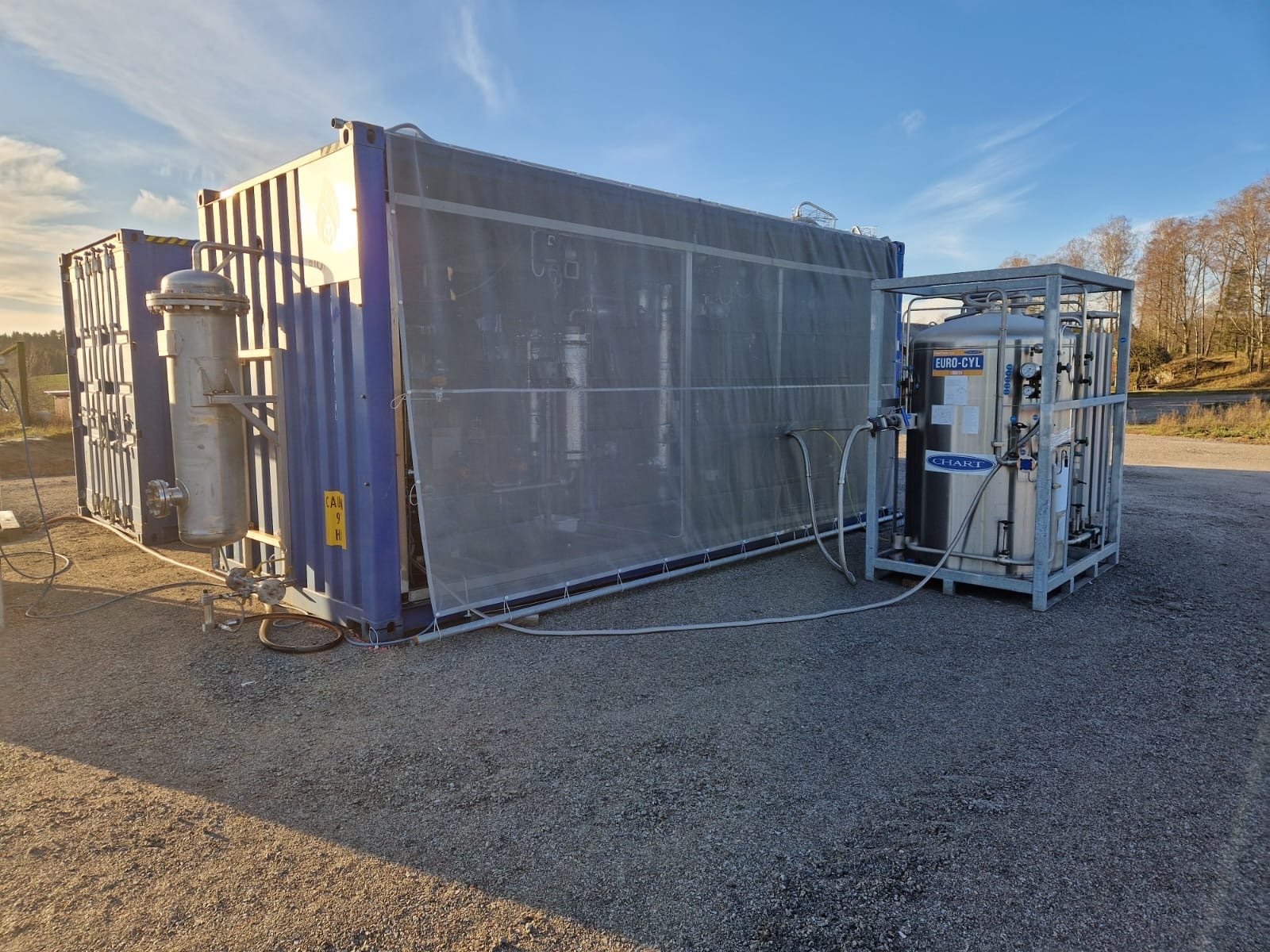
Advantages of the technology
- Compact containerised system with simple installation
- High energy efficiency with low operating costs
- Scalable solution suitable for both small and medium-sized facilities
- Opportunity to future-proof existing investments
- Creates new revenue streams from existing production.
An investment in a liquefaction plant is a relatively small investment compared to the plant already in place and is therefore a manageable investment to enable the transition to and address a new and growing market, as well as to protect existing investments.